
Diageo: craft my career
Role: User interviews, UX
How can we empower employees to have more robust career conversations, gain insight into the skills and experiences needed for broader career opportunities and challenges across Diageo?
In order to encourage talent to stay, stakeholders needed to understand the barriers employee’s faced in accessing career opportunities, and what they needed to feel empowered to take the next step within Diageo.
Myself and an external strategist co-led the research of this project. We interviewed 60 employees across the three departments that would be participating in phase 1 of the Craft my Career matchmaking tool. We hypothesized that a combination of mindset (attitudes and behaviours), skills, and practical experiences were essential to understanding the success of a given role.
After analysing and aggregating the interview data, it appeared that a combination of mindset (attitudes and behaviours), skills, and practical experiences were all essential in understanding the success of a given role. These became the metrics to determine an employee’s suitability for a role and what areas they should focus on for personal development to progress towards another role.
Diageo’s concern that employee’s weren’t aware of present opportunities were echoed amongst our interview sample, where many said they were not aware they could apply internally outside of their department. From examining the data at a high level, all of the roles demanded outstanding communication and interpersonal skills. However, after digging a bit deeper, the nuances of communication can be dissected further and trends can be refined more specifically in each area. For example, those working in sales value communication skills pertaining to one on one relationship dynamics, such as building trust, influencing others and forming partnerships. Those working in the commercial sector valued a more holistic, integrative approach to communication, emphasing the importance of story telling in conveying insights to their colleagues.
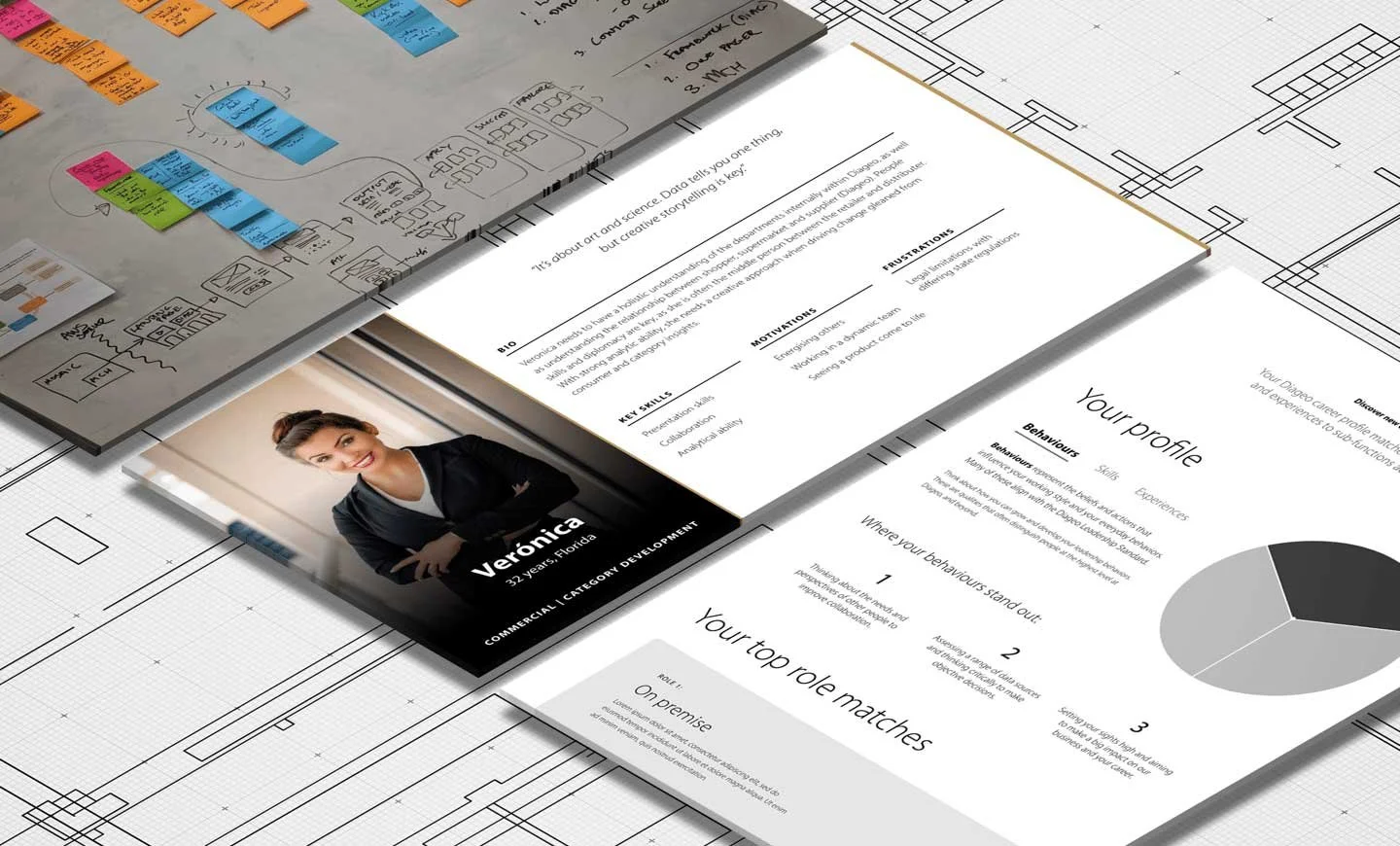
I created three user personas to reflect the key skills, frustrations and motivations of the employees in the departments to align our teams understanding. In addition, I created bubble graphs to highlight the main themes of skills that were commonly referenced for each department. From this, we created a spreadsheet to map the mindsets, skills and experiences to each role within the participating departments. We formulated the questions for the diagnostic and weighted them to match the user with relevant roles, and to show them what mindsets, skills and experiences they needed to develop for other roles.
Finally, I created the wireframes for the matchmaker tool and results page to delineate how this information would be conveyed to the user for the stakeholders.
The MVP was a huge success - 89.7% of employees found the matchmaker useful and relevant, with a rating of 4.3 out of 5 for accuracy of input. The tool internally won awards at Diageo, including the most “disruptive approach to learning”. The executive of HR labelled the tool “the most impactful thing this year”.